

Bible, Faith, Homosexuality
My Path as a Gay Christian in Germany
(Abridged version, 07.2026)
My Path as a Queer Christian
For the first time, I dare to speak publicly about my path and the tension between my faith and my identity – about what it means to be gay and Christian in Germany.
For many years of my life I tried to fit in, to suppress questions, and to hide parts of myself. But one day the longing grew too great: the longing for honesty, and for a life in which I am allowed to love.
“Spoiler”: After years, I was able to find a faith that carries me.
This text tells of my personal engagement with the Bible passages that keep coming up in this debate, and with the accusations from other Christians. So I warmly invite you to join me in my doubts, my hope, and my search for a deep faith that does not exclude, but creates space.
Perhaps you will recognize yourself in some of these thoughts. Perhaps some of it will challenge you. In any case, I invite you to think along, to listen along – and together to ask anew what it means to truly believe in freedom. (Galatians 5:1 and 5:13).
I hope that some of my experiences will help you, and that you might be spared having to clear a hurdle or two yourself.
Welcome to my life
Abridged version of the text as an audiobook (read by an AI-voice)
1. Why I am writing this text
This text is devoted to a topic that moves many people and is at the same time often avoided: the tension between Christian faith and queer identity. It is not only about homosexuality, but about the question of how LGBTQ+ people are seen, understood, and accepted in our congregations.
I write from my own perspective – shaped by my faith, my biography, and my sexual orientation. At the same time, I hope that other people from the LGBTQ+ community, as well as friends and family connected to them, will find themselves in it and discover orientation or encouragement.
This text is aimed especially at Christians who come from a rather conservative, Bible-oriented background and who seriously wrestle with how to bring together faithfulness to the Bible and appreciation for queer people. At the same time, I want to give queer Christians arguments and biblical reflections that can strengthen them in their identity and their faith. My concern is to build bridges: between theological formation, between personal history and biblical interpretation, between pain and hope.
Let me briefly introduce myself: my name is Christoph, I am 49 years old, homosexual, and born in Hanover. I grew up in a loving, stable Christian home within the Landeskirchliche Gemeinschaft Hannover, a pietistically shaped congregation. My parents were always there for me – the fact that many of my inner struggles remained unspoken for so long was not their fault, but mine.
A formative chapter of my youth was an exchange year in the USA (1993–1994) with a strictly evangelical family whose church work was strongly shaped by clear positions on homosexuality. My host mother actively worked to lead homosexual people into so-called conversion therapies. This experience is an essential starting point for my intensive engagement with the relationship between faith, sexuality, and identity.
After finishing school (Abitur) and doing my civilian service in a Protestant parish, I studied Protestant theology and English studies at the universities of Oldenburg and Hanover. The theology degree covered the central disciplines of systematic theology (dogmatics), Old and New Testament, and religious education, along with acquiring relevant knowledge of Ancient Greek and Hebrew as well as a small Latin certificate (kleines Latinum). This period of study deepened and sharpened my engagement with biblical texts and theological arguments. It forms an important background for the reflections that follow, without being their sole basis.
In this text I combine personal experience with theological reflection. I will tell both of my own path and address biblical texts and lines of argument that keep coming up in the debate about homosexuality and LGBTQ+ people in the church. It is important to me that you can follow how I arrive at my conclusions – even where you do not agree with me on every point.
I am convinced that the question of the acceptance of LGBTQ+ people in a Christian context must not be treated as a marginal issue. It touches on central aspects of identity, dignity, and community – and thus also on our understanding of how we, as the church, concretely live out the love of Jesus. Precisely for this reason, it needs a careful, informed, and responsible engagement that takes seriously both the biblical tradition and the experiences of queer Christians. In what follows, I first address fundamental tensions in this debate and describe why the topic is so emotionally charged. I then examine the biblical texts that are often used as the basis for traditional positions, and show the different interpretations that exist. The text concludes with a personal chapter about my experiences with conversion therapies and their effects on my faith, my self-image, and my path to freedom.
2. Homosexuality as a point of contention in church and congregation
In recent decades, the topic of homosexuality has led to deep tensions and painful divisions within churches and congregations. To this day a rift runs through the Christian landscape, and congregations face unresolved questions: Should homosexual couples be able to be married or blessed in church? Are openly gay people welcome in congregational ministry? How can respectful dialogue succeed when theological positions seem so irreconcilable?
Behind these questions lies a deep theological dilemma. On one side stands a traditional-conservative understanding of Scripture that defines marriage exclusively as a covenant between a man and a woman. On the other side stands a view that understands the gospel as a message of unconditional love, inclusion, and justice. Since both sides often regard their position as a core part of their faith, the discourse quickly becomes a test of endurance.
Behind the abstract debates are real people searching for identity, faith, and belonging. In the conservative congregations in which I grew up, the topic was rarely discussed openly – and when it was, it was with unease, shame, or open rejection. This silence often leads queer Christians into an inner conflict: the cruel choice between either denying their own sexual identity or losing their spiritual home. The result ranges from existential guilt to a complete break with the faith.
Two positions. Those who favor a theological rethinking emphasize values such as acceptance and inclusion, the recognition of loving, committed same-sex partnerships, and the question of justice. Those who hold to the traditional interpretation emphasize purity and holiness, marriage as an order of creation between man and woman, and the timeless validity of the written word. The central question that unites and at the same time divides both sides is: How do we understand the authority of the Bible, and how do we interpret it appropriately in the 21st century?
On the “authority” of the Bible. Among Christians there is not just one legitimate interpretation of the Bible – this is theologically and historically important to note. Almost all the great differences in church history (baptism, communion, women in ministry, spiritual gifts, predestination, the end times, slavery, head coverings in worship, and much more), as well as the definitions of the various Christian denominations, arose from the interpretation of the same Bible, not from different Bibles. It would be wrong to tell congregations close to us – such as Pietists, Baptists, Methodists, or Pentecostals, with whom we work closely together, for example, in the Evangelical Alliance – that they are simply “wrong” just because there are theological differences. Anyone who acts as if their own reading is the only possible one must explain why countless other Bible-believing Christians, who pray faithfully and study the Bible regularly, are all supposedly wrong.
None of us reads the Bible as a blank slate. We all bring a “hermeneutical lens” with us, shaped by upbringing, culture, life history, and denomination. Anyone who claims to read the Bible completely without bias is, in the worst case, confusing their own cultural formation with the voice of the Holy Spirit. Often theological rigidity does not spring from a desire for truth at all, but from a deep need for security: a closed, untouchable dogmatic system provides stability in a complex world. If one allows, even at a single point, that another interpretation might be legitimate, many fear a domino effect. But genuine faith is not measured by the rigidity of our systems, but by the resilience of our relationship with God. The various Christian denominations are like different instruments in an orchestra: they do not play the same part, but the same song. True faithfulness to Scripture is shown not in the inflexibility of one’s own opinion, but in the willingness to be questioned again and again by the word of God – following the ancient principle: in essentials unity, in non-essentials freedom, but in all things love.
3. My path as a gay Christian in Germany
I grew up in a family that gave me everything a child needs: love, stability, spiritual guidance, and a safe home. Faith was part of our everyday life, never a burden, but a foundation. But I was different. I noticed this early on – not consciously as “gay,” but simply as “different.” For years I suppressed what was stirring inside me; it was not a conscious denial, but simply a lack of self-knowledge.
In 1993/1994 I spent my exchange year in the USA, at that time a center of so-called “conversion movements.” My host mother regularly gave talks on “The Church and Homosexuals,” with the core message: homosexuals must change their orientation or cannot be Christians. This experience shaped and hurt me deeply. For the first time I became aware of how much people can harm others in the name of faith – with good intentions, but devastating results.
As a teenager I did have brief relationships with girls, but in my own perception they were not in any way comparable to what my heterosexual friends felt or described.
My path to self-acceptance was long. For a long time I hoped that God would “remove” my orientation if only I prayed enough, believed enough. This hope was painful and unhelpful. Over decades it led to shame, secrecy, and isolation – precisely because I lived within the congregation and could not share my inner struggles with anyone without risking condemnation. Only much later, through a cautious change in my prayer life, through my theological engagement, through conversations with other Christians who had had similar experiences, and through spiritual maturing, did I reach the point where I can say: My homosexuality is not the problem. Rather, the problem is the way some Christians or entire congregations deal with it.
4. How do you recognize good teaching?
A fundamental problem with the traditional interpretation of the biblical texts is that it ignores or justifies the fruit of its teaching. Jesus himself gave us a criterion in the Sermon on the Mount by which to distinguish between teachings: “By their fruit you will recognize them. Do people pick grapes from thornbushes, or figs from thistles? Likewise, every good tree bears good fruit, but a bad tree bears bad fruit. A good tree cannot bear bad fruit, and a bad tree cannot bear good fruit” (Matthew 7:15–20). This statement is radical: good teachings have good consequences. This does not mean that Christian teaching has to be easy – much of what Jesus asks of us is extraordinarily difficult: turning the other cheek, giving up one’s own life for others, forgiving without limits. But all these calls are profound acts of love that simultaneously reflect God’s love for us and honor human dignity.
The fruit of the traditional teaching on homosexuality is the opposite: emotional and spiritual devastation, loss of self-worth, isolation in congregations that should actually be a home – and, worse still, conversion therapies that lead to deep injury, depression, trauma, and even suicide. These are not good fruits. If Jesus says that bad fruit cannot come from a good tree, that should give us pause: is something wrong with our interpretation here?
A second weakness lies in Genesis 2:18: “It is not good for the man to be alone; I will make a helper suitable for him.” This verse underscores marriage as a gift of God – as the fulfillment of a basic human need. For a homosexual person, however, a person of the other sex does not “fit.” Traditional teaching demands a lifetime of being alone from homosexual people – so we declare good what God himself declared “not good.” This is a direct contradiction in its own logic, and its fruit, in turn, is painful: lifelong isolation and loneliness.
5. How we read the Bible
Whoever reads the Bible never “simply reads the text.” We always read through a lens made up of theological doctrines, congregational traditions, personal experiences, and cultural formation. Especially with the “classic” texts on homosexuality, this lens is ground particularly thick: many are convinced they already know “what it says” – Sodom = homosexuality, “abomination” = a timeless verdict of condemnation. With this concept already in the background, verses are no longer perceived anew, but merely confirmed.
This supposed clarity comes at a high price: it prevents us from truly reading the texts, and leads us to find only what we already expected. I would like to invite you to try setting aside this hermeneutical lens for a few chapters – not in order to give up the faith or to carelessly throw overboard well-founded convictions, but to give the texts the chance to speak for themselves, without prescribing from the first verse on what they are supposed to mean. In doing so, it is important to separate two things that are often unknowingly merged together in church debate: the concrete texts, which arose in a concrete language and historical situation, and our subsequent interpretations – what tradition has made of them, which terms and enemy images it has attached to them.
It is precisely here that we see how differently the Old and New Testaments speak about sexuality, violence, and social order. The Old Testament reflects a world in which patriarchal structures, the pressure to produce offspring, and the constant threat of hunger and war define the horizon. The New Testament is shaped by the emergence of the early congregations and their engagement with the pagan environment of the Roman Empire. Anyone who reads both parts of the Bible through the same pre-sorted lens risks leveling out the differences and constructing, out of very different texts, a seemingly unified “biblical opinion” that does not actually exist in Scripture itself. This path is demanding – it requires the willingness to let go of what is familiar without prematurely swinging to the opposite extreme. But only by walking it can we do justice to the claim of truly taking the Bible seriously: not as a quarry for ready-made verdicts, but as a many-voiced testimony that still challenges, comforts, and corrects us today.
The traditional theological position is based on a total of seven Bible passages – four in the Old Testament, three in the New. These are only a few verses, and yet they carry an enormous weight in church discussions and personal consciences. Let us look at them systematically: first the Old Testament texts – Sodom and Gomorrah, the incident at Gibeah, the Leviticus prohibitions – then the New Testament texts – Romans 1, 1 Corinthians 6, and 1 Timothy 1.
6. The texts of the Old Testament
Sodom and Gomorrah (Genesis 18–19)
The destruction of Sodom and Gomorrah is often cited as “biblical proof” against homosexuality. But the passage tells a different story: the men of Sodom surround Lot’s house and demand that he hand over his guests so they can violate them. This is about a planned gang rape as an act of humiliation, not about sexual orientation or loving relationships. Such situations – men wanting to “make women” of other men – are still found today in violent contexts such as prisons: sexuality becomes a weapon of exercising power, not an expression of homosexual orientation.
Lot responds to the men with a shocking offer – he offers his own daughters. This underscores the violence of the scene, but also shows: he clearly does not assume that the men of Sodom are homosexually oriented, otherwise offering his daughters would make no sense. Yes, the act is same-sex – but that is the only connection to the modern question of homosexuality. Between a gang rape and consensual, faithful partnerships lie worlds apart; no one is arguing for the acceptance of rape.
The Bible itself names Sodom’s sin: “Now this was the sin of your sister Sodom: She and her daughters were arrogant, overfed and unconcerned; they did not help the poor and needy” (Ezekiel 16:49). Jesus, too, connects Sodom’s downfall with inhospitality and the rejection of God’s messengers, not with sexuality (Matthew 10:14–15; Luke 10:10–12). Of around twenty biblical references to Sodom, only one (Jude 7) even vaguely speaks of sexual behavior at all – all the others address oppression, inhospitality, and lack of mercy. Over the centuries, however, the tradition of directly linking Sodom with homosexuality became entrenched (hence the word “sodomy”), and the story was used to legitimize the persecution of gay men and lesbians – which runs directly counter to what the Bible itself calls the “sin of Sodom.” Conclusion: Sodom and Gomorrah are not an argument against loving same-sex relationships, but a warning against xenophobia and the violent degradation of the defenseless.
Very similarly, the parallel narrative of Gibeah (Judges 19:22–29) shows a planned act of collective rape as an expression of violence, not of love: here too, “wicked men” surround the house and demand that a guest be handed over; the text describes the total breakdown of hospitality, law, and protection for the weak. Sexual violence was a well-known means in the ancient Near East to demonstrate power and humiliate enemies: the Song of Deborah imagines rape as a matter-of-course spoil of war (Judges 5:28–30), and prophetic texts such as Isaiah 47:1–3 and Jeremiah 13:22 use the rape of women as an image for military defeat and disgrace. Where same-sex rape appears in biblical texts, then, it is an instrument of violence and humiliation – not an assessment of loving, responsible relationships, which is what this text is about.
Leviticus 18:22 and 20:13
“Do not lie with a man as one lies with a woman; that is detestable.” These are the only two Old Testament verses that explicitly address male same-sex sexual acts. In more recent exegesis, however, it is widely disputed that this represents a timeless prohibition directly transferable to today’s relationships. Biblical scholar Thomas Hieke emphasizes that the term “homosexuality” is anachronistic for the Hebrew Bible – the ancient world did not know same-sex partnership as an identity-based way of life. The prohibitions stand within the context of the so-called Holiness Code, which had in view the preservation of offspring and the demarcation of a small community living under foreign rule.
In the ancient Near East, almost everyone married very young, a “single existence” as we know it today practically did not exist, and every man, as head of the household, was expected to father many children. Against this background, two reasons become visible for why the act is condemned so sharply in Leviticus: a man who let himself be made “into a woman” through anal intercourse broke the gender hierarchy of the time and took on a role considered inferior; at the same time, male seed was regarded as a precious, limited life substance, whose “waste” appeared as a squandering of the life-material needed for offspring. The texts are thus strictly act-oriented and judge a single sexual act within a patriarchal society – they know neither the modern concept of a stable homosexual identity nor that of a lifelong, equal partnership.
The argument that the prohibition must therefore remain valid because adultery and incest are also forbidden in Leviticus does not hold up on closer inspection either: just three verses later (Lev 18:19), sexual intercourse during menstruation is also forbidden as an “abomination” – a prohibition that hardly anyone today still considers binding. The prohibitions of adultery, incest, and bestiality are repeated several times in the Old Testament in Exodus, Numbers, Deuteronomy, and the Prophets; the prohibition of male same-sex contact, by contrast, appears only in Leviticus, alongside dozens of other regulations that Christians have long since ceased to regard as binding. The Hebrew word for “abomination” (toevá) often denotes cultural and cultic difference in the Old Testament, not automatically a timeless moral truth – it is, for instance, also an “abomination” for Egyptians to eat with Hebrews, and vice versa (Gen 43:32). And the fact that an act was punishable by death in the Old Testament does not mean Christians today must regard it as sinful: working on the Sabbath (Ex 35:2), blasphemy (Lev 24:16), childhood disobedience (Deut 21:18–21), wearing mixed fabrics (Lev 19:19), and eating shellfish (Lev 11:10) were also punishable by death. Notably, there is not a single narrative in the entire Bible in which a punishment for same-sex acts is actually carried out – the verses are normative texts, not recorded cases.
A substantial part of the New Testament deals with the question of what place the old Jewish law has in the emerging Christian church. This question was decided in 49 AD at the Council of Jerusalem: the early apostles – among them Peter and James – concluded that the old law was not binding for Gentile Christians, not even the most central signs of Jewish identity such as circumcision or dietary laws (Acts 15). Paul later summarizes this: Christ is “the end of the law” (Rom 10:4) and frees believers from the “yoke of slavery” that the old law represented (Gal 5:1). If Christians are thus no longer bound by dietary laws, no longer practice circumcision, and are permitted to work on the Sabbath – why, then, should they hold on precisely to the two verses in Leviticus 18:22 and 20:13, while declaring the vast remainder of the same law “obsolete”?
Conclusion on Leviticus: These verses are part of an old law that was fulfilled through Christ. They no longer have direct validity for Christians today – just as little as the dietary laws or purity regulations. In light of the ancient world and the Bible’s own internal development of the law, they cannot be read as a timeless verdict of condemnation on loving, responsible same-sex relationships.
7. The texts of the New Testament
Romans 1:26–27: The heart of the debate
“Because of this the women exchanged natural relations for unnatural ones. In the same way the men also abandoned natural relations with women and were inflamed with lust for one another. Men committed shameful acts with other men […].” This passage is traditionally regarded as the definitive argument against homosexual relationships – it is also the only place in the entire Bible that explicitly addresses female same-sex activity. A historical-critical reading, however, shows: Paul, as a Hellenistic Jew and Roman citizen strongly shaped by Stoic philosophy, is here addressing a decadent, privileged upper class of the great Roman cities – people who, out of excess and satiety, tried out every conceivable sexual experience. The theological logic in Romans 1:18–32 unfolds as a coherent argument about humanity’s godlessness: the Gentiles could have recognized God through creation, but chose to reject this truth and serve created things instead of the Creator. From verse 24 on, Paul describes the consequence: God’s judgment consists not of fire and brimstone, but of a painful independence – God “gives them over” to their own destructive passions.
The historical practices Paul had in view were marked by extreme social asymmetry: cultic sexual excesses, pederasty (institutionalized love of boys as a demonstration of power), the sexual exploitation of slaves, and the licentiousness of married men who, out of satiety, took additional partners. Decisive is the logical structure of the argument: Paul describes people who were naturally heterosexually inclined and who consciously abandoned these relationships out of a craving for new stimulation – a deliberate “exchange.” Homosexual Christians today do not undergo any such switch: their orientation is deep-seated, often felt from birth, not the result of turning away from a previously lived heterosexuality. Since same-sex relationships today are lived within a context of monogamy, love, and respect, they lack any connection to the unbridled lust or idolatry that Paul criticizes.
One must bear in mind: Paul simply did not know the modern concept of a stable, innate homosexual identity – the diaries and life accounts that today give us deep insight into an innate sexual identity were simply not available to him. His textual basis was the observation of ancient power structures and excesses. Paul’s theological analogy works only if one begins with a heterosexual orientation and consciously rejects it. Believing queer people who worship the one true God and live in faithful partnerships simply do not fall under the group Paul outlines. In summary: Romans 1 condemns sexual exploitation, the excess of a satiated upper class, and the destructive consequences of idolatry – a blanket condemnation of modern homosexual partnerships cannot honestly be derived from it. Paul himself closes the letter to the Romans later with an admonition that could serve as a guide for this whole debate: “Let us stop passing judgment on one another […]” (Rom 14:13).
1 Corinthians 6:9–10 and 1 Timothy 1:10
Here Paul is writing to the congregation in Corinth, one of the largest and culturally most diverse cities of the ancient world, which struggled with considerable ethical and social problems – from internal disputes and lawsuits to sexual misconduct. Verses 6:9–10 stand within the framework of a so-called “vice list,” a rhetorical form common in antiquity in which various behaviors are listed as examples. Paul’s concern here is not a systematic sexual ethic, but a pointed warning to a specific congregation marked by conflict and moral disorientation.
Here Paul uses two Greek terms that are often associated with homosexuality: malakoi (“soft ones”) and arsenokoitai (translated by Luther as “boy molesters”). Both terms are extraordinarily unclear in ancient literature, and in the first century there was no concept of sexual orientation as we know it today at all. Malakoi literally means “soft” or “effeminate” and was used very broadly in ancient usage: for moral weakness, lack of self-control, a luxurious lifestyle, or men who were socially regarded as “unmanly.” In sexual contexts it could refer to passive roles or male prostitutes – what matters is that the term does not describe a sexual orientation, but evaluates behavior within the framework of ancient, strongly hierarchical notions of masculinity, in which a “free” man was always supposed to take the active, dominant role. Arsenokoitai is a compound apparently coined by Paul himself, from “arsen” (man) and “koite” (bed) – a so-called hapax legomenon that appears only twice in the New Testament (1 Cor 6:9; 1 Tim 1:10) and is barely attested outside it. There is therefore no secure meaning. This is precisely why the widespread translation as “homosexuals” is problematic: this term did not even appear until the 19th century and presupposes a modern understanding of sexual identity that did not exist in Paul’s time.
The translation history is telling: it was not until 1946 that the Revised Standard Version first translated arsenokoitai as “homosexuals” – and revised this again in 1971 after the justified objection of a theology student, because the modern concept of identity must not be read back into the ancient text. The influential New International Version also removed the word “homosexual” entirely in 2011 and has since translated it as “men who have sex with men.” Conservative translations such as the ESV (2001), by contrast, deliberately retained the term “homosexuals.” This disagreement among scholars and translation committees themselves shows that this is by no means a clear, uncontested textual basis.
In the context of 1 Corinthians 6 – a “vice list” within a letter to a congregation marked by conflict and exploitation – and 1 Timothy 1 – where arsenokoitai stands directly next to “slave traders” – it seems plausible that Paul has in view concrete exploitative practices: the sexual access of wealthy men to slaves, prostitutes, or socially dependent persons, including the widespread practice of pederasty. Had Paul wanted to condemn same-sex relationships in general, he could have drawn on already-existing, clearer Greek terms; instead he coins a new, rare word. Timothy, moreover, worked in Ephesus, a city known for its cult of Artemis, in which religion and sexuality could be closely intertwined – a further indication of a cultic-exploitative rather than a general identity-related context. A common objection is that Paul here places homosexual people on the same level as murderers and slave traders; but this conclusion already presupposes that “arsenokoitai” means “homosexuals” – and that is anything but linguistically certain.
Conclusion on the New Testament texts: None of these three passages clearly refers to loving, long-term, equal partnerships between adults. Romans 1 speaks, in the context of idol worship, of a conscious switch in sexual practices, not of innate orientation. 1 Corinthians 6 and 1 Timothy 1 use linguistically highly unclear terms, which have been rendered in extremely different ways throughout translation history.
8. Sexual orientation, love, and the calling to relationship
Orientation is more than sex. The most common misunderstanding in this debate is equating sexual orientation with sex alone – gay people = sex, so the unconscious cliché goes. This is and remains false. It would be more accurate to say: sexual orientation is the capacity for love – not just for intercourse. Heterosexual people usually do not consciously think about their orientation; it is simply part of who they are. But it enables them to fall in love, to build a deep emotional bond, to start a family. Homosexual people have the same capacity for romantic love and devotion as heterosexual people – I have gotten to know many gay and lesbian couples and seen how profound, loving, and self-sacrificing their partnerships are. Traditional teaching tells heterosexual people: your sexuality is a gift from God, celebrate it in marriage. But to homosexual people, who care just as much about love, partnership, and family, it says: no – even a loving, monogamous partnership is sin and excluded for life. This is asymmetrical and raises the question of why a just God would impose this exclusively on one particular group of people.
The problem of forced celibacy. Paul writes in 1 Corinthians 7 that celibacy is a gift – but not everyone has this gift; whoever cannot remain abstinent should marry. Traditional teaching, however, demands abstinence from homosexual Christians regardless of any calling to it: forced celibacy without the gift. Moreover, Paul’s recommendation of celibacy was strongly shaped by the early Christian expectation of the imminent end of the world – the conviction that the world would soon pass away (“for this world in its present form is passing away,” 1 Cor 7:31). Transferring this temporary crisis-recommendation as a timeless law onto a modern human life of 80 years distorts the apostle’s original intention – especially since in antiquity the concept of an unchangeable sexual orientation as part of one’s identity did not yet exist at all. It is also worth noting the theological double standard here: although Jesus explicitly forbids divorce in the Gospels (while saying not a single word about homosexuality), almost all conservative and evangelical congregations today permit remarriage after divorce – out of pastoral mercy toward people who are simply not called to celibacy. Homosexual Christians are denied this theological flexibility; they are measured against an absolutist standard that has long since been abandoned for heterosexuals. Behind this also stands an impoverished understanding of partnership, one that reduces a relationship purely to the sexual act to be abstained from, and overlooks the fact that it is about mutual care, faithfulness, and bearing responsibility for one another – including, for instance, standing by a loved one in illness or being at their side at the end of life.
Gender before God. God created human beings as male and female (Gen 1:27) – which, conversely, means that God himself unites this diversity within himself. Scripture uses maternal as well as paternal metaphors for God (Hosea 13:8; Isaiah 66:13) and personifies divine wisdom as a female figure. In Galatians 3:28, Paul draws the radical conclusion: “There is no male and female, for you are all one in Christ Jesus.” Even church fathers such as Gregory of Nyssa emphasized that the division into male and female is a characteristic of transient biological nature, while the actual “image of God” in humanity stands beyond gender boundaries.
Change in church history. Where do we ourselves stand in the way of an open or new interpretation? We often approach the topic in a very legalistic way – exactly the approach Jesus regularly criticizes in the Pharisees. When healing the man with the withered hand on the Sabbath, he asks: “If any of you has a sheep and it falls into a pit on the Sabbath, will you not take hold of it and lift it out? […] Therefore it is lawful to do good on the Sabbath” (Matthew 12:11–12). And in 2 Corinthians 3:6 we read: “He has made us competent as ministers of a new covenant – not of the letter but of the Spirit; for the letter kills, but the Spirit gives life.” Both passages challenge us to look beyond the text and to let ourselves be guided by God’s Spirit.
Church history also shows that profound changes in biblical interpretation are not only conceivable, but have already happened. The Reformation of the 16th century, with the principle “sola scriptura,” freed the Bible from the exclusive interpretive authority of the ecclesiastical institution and made it accessible to individual believers – though even the Reformers, such as Martin Luther, were not free from the limitations of their time. Slavery, nowhere abolished in the New Testament, was recognized centuries later by Christian abolitionists, on the basis of the fundamental motifs of being made in God’s image and love of neighbor, as incompatible with the gospel – the theological controversy was ultimately fought out in the American Civil War. The heliocentric worldview, too, forced the church to rethink: for centuries, Bible verses such as Joshua 10:12–13 (the sun and moon “stand still”) or Psalm 93:1 and 104:5 (the earth “firmly established”) had been read as scientific facts; even Luther argued against Copernicus by citing Joshua. With Galileo’s observations, it slowly became clear that such verses are poetic, phenomenological images – not physical treatises. Even the biblically attested practice of polygamy – never explicitly forbidden by God, but still regulated under Mosaic law (Deut 21:15–16) and practiced by Abraham, Jacob, and David – was only overcome in the course of church history in favor of an ideal of equal monogamy, once it was recognized that Old Testament polygamy was a deeply patriarchal instrument of power.
These historical learning processes call for humility: if we acknowledge that the biblical authors wrote about the universe from the horizon of their ancient state of knowledge, we must apply the same standard to their statements about human sexuality. The biblical writers knew neither modern psychology nor the phenomenon of a deep-seated, not self-chosen, love-oriented homosexual orientation. Whoever applies those ancient verses uncritically to faithful, same-sex partnerships today commits the same hermeneutical error as those who once used Psalm 104 to deny the movement of the earth. The church does not lose its foundation when it learns from reality – on the contrary: it honors the Creator by acknowledging the truth of reality.
Prayer as a space of spiritual discernment. A professor of Protestant theology once told me, regarding the ethically delicate topic of euthanasia, that such issues, given the few and mostly problematic biblical texts, can ultimately only be answered in prayer. The same applies to homosexuality and faith: when the biblical evidence is interpreted differently, or when the ancient texts simply do not reflect today’s lived reality, purely historical-critical exegesis reaches its limits. Prayer is then not a theological stopgap, but the actual place where ethical insight and relationship with God come together – the Christian tradition knows this as spiritual discernment (discretio spirituum): not mere wishful thinking, but a structured process of testing under the guidance of the Holy Spirit, in which reason is not switched off, but brought before God in prayer.
Already in the Old Testament, God’s answer often lies not in the “storm” or “earthquake” of dogmatic certainties, but in the “gentle whisper” (1 Kings 19:12). Jesus himself, before existential decisions, instinctively withdrew into prayer – before calling the disciples (Luke 6:12) and in Gethsemane (Luke 22:41–44); if even the Son of God sought the answer in wrestling dialogue with the Father, this shows that God’s will for concrete life first takes shape in prayer. Jesus also promises his disciples that the Holy Spirit will “guide them into all truth” (John 16:13) – a dynamic, future-oriented process that opens up the word of Scripture anew for the present moment. And in the letter to the Philippians, Paul calls on believers to bring all their worries before God in prayer; the result promised is not a finished legal text, but this: “And the peace of God, which transcends all understanding, will guard your hearts and your minds in Christ Jesus” (Philippians 4:6–7). This given, deep peace is a central criterion for whether a decision reached is in keeping with God’s will.
Prayer thus leads us away from a purely legalistic, letter-bound ethic toward a living ethic of relationship and responsibility. Countless homosexual Christians worldwide share exactly this experience: a deep, years-long wrestling before God, not a fleeing from the Bible. Where human arguments reach an impasse and the church has no clear answers ready, prayer becomes an existential refuge – and many experience there no more contradiction between their created identity and their faith, but a deep peace given by God.
9. Conversion therapies and their consequences
For believing Christians who discover a same-sex attraction in themselves, a whole world often collapses. Caught between love for God and an unwanted sexuality, the “ex-gay movement” appeared to many – as it did to me at the time – to be the only way out.
These organizations long advertised with slogans like “Freedom from Homosexuality” and presented supposed success stories of people who had been “healed” through Jesus and were now happily married heterosexually. For those seeking help, these accounts created the hope that a complete transformation through faith, prayer, and therapy was possible.
What is conversion therapy? Psychological, religious, or medical interventions aimed at changing sexual orientation – these include psychological counseling and prayer, religious rituals and “exorcisms,” stays at conversion camps, aversion therapies (conditioning through punishment), hormone treatments, and, in extreme cases, physical abuse. Many of these approaches rely on the so-called reparative-drive model, which is based on psychoanalytic theories from the 1950s and 60s (including the work of Irving Bieber) and was later further developed in a religious direction by the Christian theologian Elizabeth Moberly. The core assumption: homosexuality is not a stable variant of human sexuality, but results from an early childhood attachment deficit – primarily a “distant or hostile” father and an overprotective mother. Homosexual attraction is then interpreted as an unconscious “reparative” attempt to compensate for this emotional deficit. The therapeutic approach then tries to close this supposed gap through intensive, non-sexual friendships with Christians of the same sex – in the assumption that the homosexual feelings will then disappear. For people who simply feel no attraction to the other sex at all, these approaches offer no fitting explanation, only a sense of guilt.
What the research says. On closer examination, the promised “healing” turns out to be an illusion. Since homosexuality is regarded as deeply shameful in the affected congregations, many of these groups operate in strict secrecy, which only intensifies participants’ sense of isolation and of “being broken.” Such therapies do not lead to genuine transformation, but to exhausted suppression: participants remain, even after years, homosexually oriented at their core, live in constant inner conflict, and have merely learned to control their feelings with extreme effort, while mottoes of perseverance such as “you just have to work harder on yourself” shape everyday life. The claim that homosexual people typically have disturbed relationships with their parents does not hold up to scientific scrutiny: empirical studies show no robust correlation between family relationship structures and sexual orientation; the corresponding assumptions are based predominantly on selective individual case reports rather than on systematic research.
Against this background, major professional organizations have taken a clear position: the American Psychological Association, the American Medical Association, and the American Psychiatric Association all agree that conversion therapies are neither effective nor safe and can be associated with significant psychological risks; they regard such procedures as ethically problematic. The World Health Organization (WHO) already clarified in 1990 that homosexuality is not a mental disorder, and accordingly removed it from the international classification of diseases. Since May 2020, conversion treatments on minors, as well as on adults acting under pressure or coercion, have been a criminal offense in Germany under the law for the protection against conversion treatments – advertising such offers is also illegal; similar protective provisions apply in Austria and parts of Switzerland.
My own experience. During my exchange year in the USA, I saw up close how these “therapies” proceed and how much harm they cause, both in the short and the long term. My host mother – whom I respected, who loved me – was convinced that homosexuality was a mental disorder that could be “healed.” She offered for me to take part in one of these “reversal programs”; she did not mean it maliciously, but the message was clear: the way you are is not acceptable. I declined these offers after attending two sessions of such a group – more out of instinct than conscious conviction. In these sessions I felt that the participants, already deeply broken believers, were not being led toward a “healthy,” liberated heterosexuality, but rather, through the repeated message of their own inferiority, toward a life of lifelong suppression, shame, and permanent inner conflict. In my view, no one succeeded – not even the leaders of these groups.
In 2004 and 2005 I nevertheless underwent therapy sessions in Germany with the organization Wüstenstrom, the German counterpart to Exodus International, because I wanted to leave nothing untried – I wanted to do everything to have this supposedly damaged person, myself, repaired. The result was equally sobering: no change, despite intensive prayer and the constant message that my sexuality was not good and urgently needed to change. The mottoes of perseverance became fragile straws I clung to, but they led mainly to further self-doubt: had I simply not yet prayed the right prayer? Did I not believe strongly enough? Every setback was recorded as a failure. Since most approaches sought the cause in the role of the father or the mother, I began to look for blame in my family – this narrative drove a wedge between my parents and me, even though they had done nothing to cause me to be the way I am. This became especially clear to me later, when I came out to my parents and they asked me whether they had done something wrong – I had to tell them that this was not the case.
At that point I was so destroyed, weak, and hopeless that I had perfectly planned my suicide and fully intended to carry it out. Today I can only deeply thank God that he prevented this at the very last second through his direct intervention. The therapy sessions brought no improvement whatsoever in my feelings or my orientation, but instead drove a wedge into my relationship with my parents, my brother, and above all with God. Later I learned from friends from my time in the USA, who had gone further down this path and stayed on it longer, of deep shame, of the feeling of being “broken,” of psychological trauma from manipulative techniques, of broken marriages that children also suffered under – and, in one extreme case known to me, of suicide. We really must not forget: this is about people. About lives that were destroyed in the name of faith.
The responsibility of congregations. Evangelical and conservative congregations that actively support or tolerate conversion therapies bear responsibility for the suffering that results from them – this is not a matter of “differing theological positions,” but of ethics and harm. Many of the largest “ex-gay ministries” have since dissolved themselves and publicly admitted guilt: Exodus International, the world’s largest umbrella organization of the movement, closed in 2013; its president, Alan Chambers, published a comprehensive apology titled “I Am Sorry” for the emotional pain, shame, and trauma the organization had caused – after previously stating publicly that practically no one he had encountered in the movement had experienced any genuine change in sexual orientation. The longtime director of Love in Action, John Smid, later came out as gay himself and drew the sober conclusion that in all his years he had not witnessed a single man undergo a genuine, lasting transformation – the supposed successes, he said, had merely been the result of psychological pressure and self-deception. John Paulk, too, the face of the influential “Love Won Out” conference series run by Focus on the Family, later formally distanced himself from his own books and emphasized that the belief in a changeable orientation was false and had caused immeasurable harm.
In the German-speaking world too, the “ex-gay scene” has changed considerably since then: organizations like Wüstenstrom now operate under new names and with supposedly more harmless terms like “identity work” or “faith-based counseling” – but the underlying dynamic of suppression and shame remains the same. Both the Evangelical Church in Germany (EKD) and the German Bishops’ Conference of the Catholic Church now firmly reject such attempts at change in their official statements, and emphasize that sexual orientation is a fixed part of a person’s personality that requires no “repair.” Nevertheless, there are still organizations and congregations that offer, endorse, or quietly accept such “therapies.”
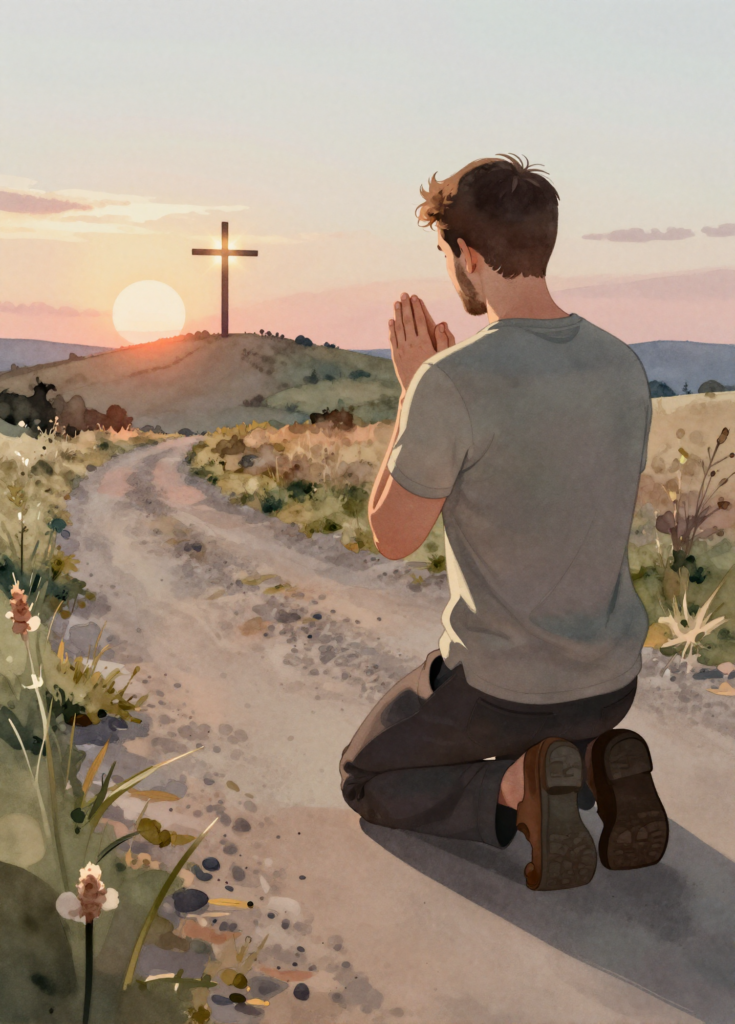
10. My path in prayer
For almost two decades I prayed daily for healing. Since nothing changed, I changed my prayers – no longer for “healing,” but for understanding, grace, and truth: “Lord, who am I really? How does this fit into your plan?” God did not answer these prayers with healing in the sense I had originally hoped for. Instead, over the years, he helped me to accept myself the way he loves me.
This is a different kind of healing. Healing from shame. Healing from self-contempt. Healing from the lie of being “broken.” My conclusion: I am gay. I am a Christian. I live by God’s grace (Romans 3:23) and am redeemed through Jesus Christ. All of this together is possible, and it is no disgrace – it is a reason for my praise and thanks.
11. The responsibility of congregations in dealing with LGBT Christians
Congregations almost always have people among them who are gay, lesbian, or bisexual – even when this is passed over in silence. A large, population-representative US study with over 160,000 respondents (published in 2023 in the American Journal of Preventive Medicine) shows: while religious practice is, on average, associated with lower suicide risk among heterosexual people, this connection is partly reversed among homosexual and bisexual people. This does not mean that faith itself is destructive – rather, it shows that religious spaces become a burden when belonging is made conditional and identity is devalued.
These figures must not be misunderstood too quickly: the study does not claim that faith or congregation are inherently destructive. Rather, it shows that religious spaces become a burden for sexual minorities when belonging there is tied to conditions, identity is devalued, or one’s own existence is continually called into question. What is a place of comfort for many can, for others, become a place of growing inner conflict.
From this arises a fourfold obligation for congregations: first, serious theological engagement instead of dogmatism and a reflexive defensiveness against uncomfortable findings – where empirical research shows that religious practice can be associated with increased suicidality for some of those affected, theology must not ignore this reality. Second, pastoral sensitivity: those who speak of pastoral care must not only speak of truth, but must also ask whether their own tone and their own structures build people up or break them down. Third, an invitation to a broad table – also listening to theologians, pastoral workers, and those affected who, for good reasons, press for a rethinking, rather than keeping the debate confined to narrow internal church echo chambers. And fourth, the courage to ask uncomfortable questions: not every instance of hurt disproves a position, but every ongoing and systematic pattern of hurt obligates us to examine whether we are truly interpreting God’s word correctly. When it is precisely spaces of faith that are associated, for some people, with increased suicidal distress, silence is not spiritual sobriety, but a failure toward those who need protection. A merely abstract, theological engagement does not bring people to Jesus – warm, accepting conversations, deep listening, and catching people in moments of exhaustion are far closer to the example of Jesus.
Studies also show that many young people primarily associate the church with the rejection of homosexuality. It would be a healing sign if coming generations experienced Christianity not primarily as “anti-homosexual,” but as merciful and credible. The plea is addressed to all believers: take this topic seriously, talk to the people in your congregation who are gay or lesbian, listen to them. The hope is that congregations will learn to love people before judging them theologically (Romans 14:13).
12. Positive recent developments in German free churches
The free-church landscape in Germany is no longer uniform on the topic of homosexuality. The United Methodist Church in Germany (Evangelisch-methodistische Kirche) has taken a particularly clear position: its Central Conference decided in 2022 to fully integrate homosexual people – including the possibility of church blessings for same-sex couples and the ordination of homosexual people for pastoral ministry, while at the same time protecting the conscience of pastors who do not wish to take this path.
It is notable that with this step, the United Methodist Church is not merely expressing tolerance, but fundamentally recognizes homosexual Christians as people who, with their gifts and their calling, belong to the church. This development contradicts the frequently made claim that a Bible-oriented free church can only deal with homosexuality by way of prohibition or silent toleration.
Movement is also visible in the Federation of Free Evangelical Congregations (Bund Freier evangelischer Gemeinden), though more cautiously and with more conflict: the federal leadership, in its guiding recommendation, continues to hold to a conservative assessment, but acknowledges that individual congregations are taking other paths, and that this tension within the federation currently has to be endured. There are some examples of evangelical congregations that, after a longer process of dialogue and learning, are now officially recognized as a “welcoming congregation.” The Zwischenraum network lists such welcoming congregations, in which queer people are explicitly welcome and can contribute their gifts; the mere existence of such a directory shows that spaces are opening up within evangelical circles that would hardly have been imaginable just a few years ago. In the congregationally organized Union of Evangelical Free Church Congregations (Baptists), there is no federation-wide regulation – local congregations decide for themselves, which means very different practices exist within the same federation, ranging from cautious distance to clear openness. One example is the Berlin Friedenskirche, which married a homosexual couple in 2022.
This is of considerable significance for the debate as a whole: anyone who claims that Bible-believing or evangelical congregations can, in principle, only accept homosexual people while excluding their capacity for lived relationships must take note that reality has since become more complex. This does not mean that the debate is over – much remains conflicted and painfully open. But for those affected, a single open congregation can make the difference between a spiritual home and lifelong estrangement.
These developments show: traditional teaching is not the only option. When congregations, after serious wrestling, arrive at more open solutions, this path must not be too quickly dismissed as a betrayal of biblical truth – rather, it is worth asking what fruit such decisions bear (Matthew 7:16–17). Romans 15:7, too, sets a clear tone: “Accept one another, then, just as Christ accepted you.” Christian community does not begin with suspicion, but with acceptance.
13. Closing words
Thank you for letting me take you along into my life. This topic is not easy – no, it is painful, but it is essential. It is about people.
It is about my friend David (name changed), who came from a Bible-believing family, hated himself for years, and left the congregation – and found a new home in a different, more open congregation. It is about Nina, who, as a believing Christian, came out and lost contact with her parents, her friends, and her entire congregation. Sadly, it is also about Frank, who, in a charismatic congregation, kept hearing that he did not pray enough because he had not experienced “healing” – this pressure eventually drove him to suicide. It is about thousands who were traumatized in conversion programs, and about countless homosexual people who live in loneliness because their congregation communicated to them that love, for them, is sin.
But it is also about hope – the hope that things can be different: that congregations can be healing, loving, and honest, if they are willing to examine their teachings in the light of Holy Scripture and their living effects. In this way, congregations can reach people they do not yet know, or who have previously turned their backs on them.
The goal of every church, every congregation, every Christian should be to be recognizable as people who do not condemn others first, but meet them in truth and love. I therefore do not end with condemnation, but with a request and with hope. This request is addressed to all believers: take this topic seriously. Talk to the people in your congregation who are gay or lesbian. Listen to them. Try to understand their experiences. In all these encounters, let us carry in our hearts the greatest commandment, the double commandment of love (Deuteronomy 6:4–5 and Leviticus 19:18).
Faith – unlike our God – is not a stone fortress that must be defended at any cost and without regard for losses. Faith is a living relationship with God and with people. Relationships are most alive when there is room in them for questions, doubts, genuine wrestling. Room for growth and unfolding – in every area of life.
Further reading
For readers with a personal interest in this theological debate.
The ideas about good fruit, about it not being good for man to be alone, and the argument concerning celibacy, come from Matthew Vines. His book is highly recommended for Bible-believing Christians!
- Matthew Vines: God and the Gay Christian: The Biblical Case in Support of Same-Sex Relationships, Convergent Books, New York, 2014.
- Justin Lee: Torn: Rescuing the Gospel from the Gays-vs.-Christians Debate, Jericho Books, 2012.
For professionals in psychology and pastoral care:
- American Psychological Association: Guidelines for Psychological Practice with LGBTQ+ Persons, 2015/2023.
For congregational leaders and pastors:
- Netzwerk Zwischenraum: directory of welcoming congregations, online at zwischenraum.net
For affected parents:
- Greg & Lynn McDonald: Embracing the Journey: A Christian Parents’ Blueprint to Loving Your LGBTQ Child, Howard Books, New York, 2020.
This text is a heavily abridged version for bunterglaube.de. It is intended as a personal testimony and an invitation to reflect for yourself – not as a final theological judgment. Those who wish to go deeper will find further argumentation in the books and sources mentioned.
The full, complete version is planned to appear later as a bound book and as an e-book.